


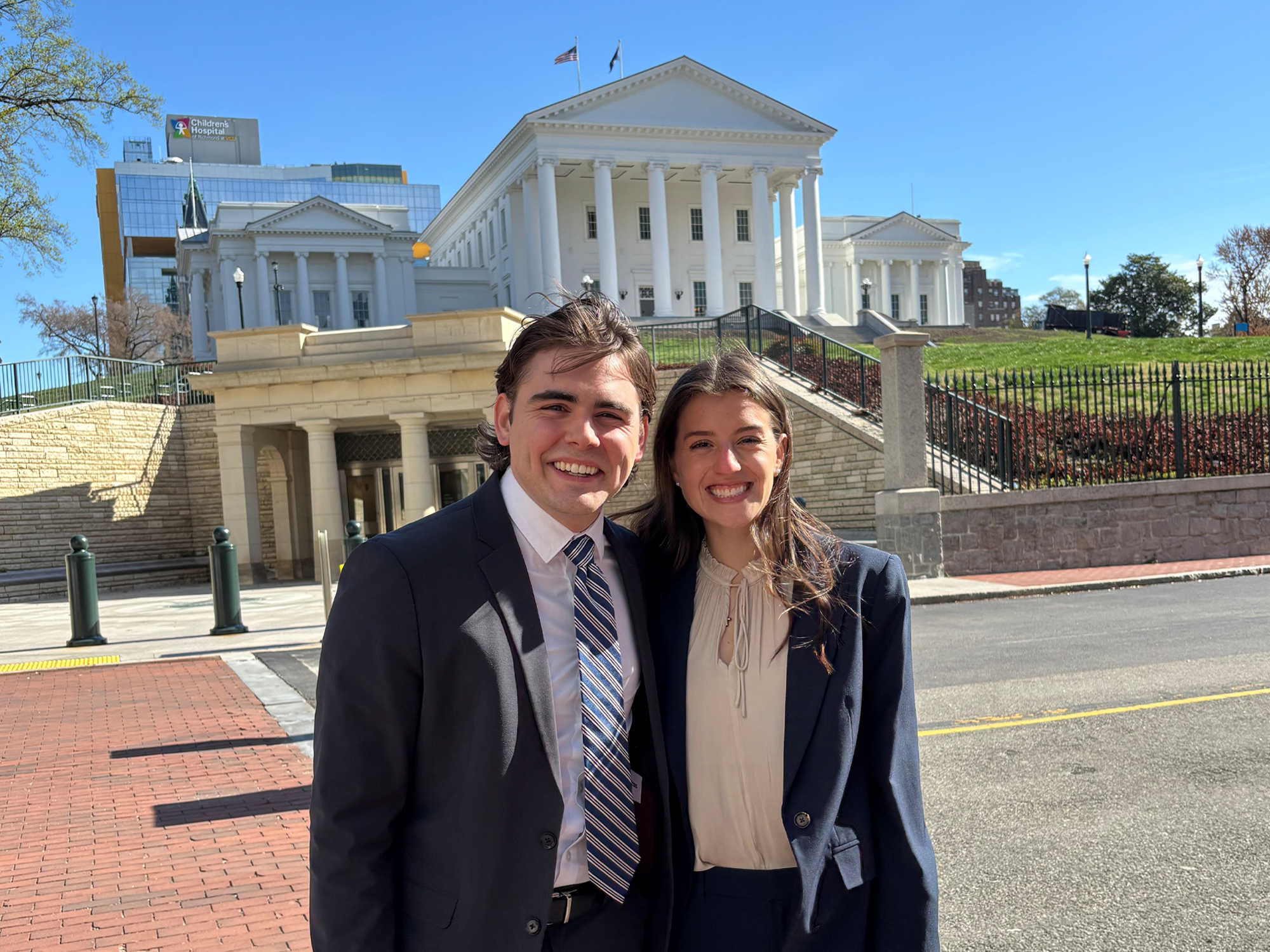
For nearly six decades, the School of Law’s experiential learning and clinical programs have provided life-changing experiences for the hundreds of students who have enrolled, not to mention the thousands of clients who have benefited from the services they received.
The school currently offers 10 clinics and seven externships. The Criminal Defense Practicum (formerly the Legal Aid Clinic) is the oldest offering, while the Land Conservation Clinic (established in 2023) is the newest.
In recent years, the school has averaged 425 School of Law students enrolling or re-enrolling in one of the school’s clinic/externship programs each year and cumulatively engaging in roughly 88,000 service-learning hours annually. More than 26,500 of these hours occurred under the direct supervision of law school faculty members directing in-house clinical programs.
The following provides an overview of the current clinics and externships on offer, with highlights from students and recent successes.
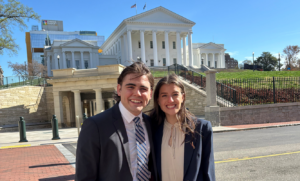
Appellate Litigation Clinic students Chan Creswell and Emma Rose Bagwell presented oral argument before the U.S. Court of Appeals for the Fourth Circuit in March.
Founded in 2010, the Appellate Litigation Clinic is one of the older appellate clinics in the country. The clinic accepts cases in the Georgia Supreme Court; the U.S. Courts of Appeals for the Second, Fourth, Fifth, Seventh, Ninth, Eleventh and D.C. Circuits; and the Board of Immigration Appeals. This past year, under the direction of Thomas V. Burch, third-year students argued six cases. The students were: Chandler S.K. “Chan” Creswell and Emma Rose Bagwell (Fourth Circuit), Kerolls “Kero” Gadelrab and Avery C. Hill (Ninth Circuit), Julia A. Gillies and Katelyn W. Hulsey (Ninth Circuit), Jesse L. Sebring and Mark S. Winokur (Eleventh Circuit), Katie A. O’Neal and Harrison J. Demas (Eleventh Circuit) and Casey E. Smith and Sydney M. McRae (Eleventh Circuit).
The Business Law Clinic is a transactional clinic that allows UGA Law students to provide a wide range of legal services to small businesses, nonprofits, start-ups and entrepreneurs while working under the direction of Associate Dean for Clinical Programs and Experiential Learning Willow Tracy.
Second-year student Cade Mataya said he learned the practice of business law is an iterative process. “While I never expected that anything I produced would be used without a lot of edits, I learned what the process of improving a document looks like … . Rather than being a static ‘paper-pushing’ practice built purely on precedent documents, business law is a very dynamic process where you learn a variety of things, from how to format a document to analyzing the circumstances that led to a provision being included in a precedent document.”
The Capital Assistance Project was initiated in 1998 at the request of the Supreme Court of Georgia. Participating students work at agencies defending individuals charged with or convicted of capital crimes. Students support attorneys with trials, direct appeals and habeas petitions, including investigating and reviewing evidence, drafting motions and conducting witness interviews. Clinical Professor Jessica L. Heywood (J.D.’97) oversees this clinic.
Nearly 90 students each year complete the part-time Civil Externship, led by Clinical Associate Professor Elizabeth M. Grant (J.D.’94).
Regarding his externship with Senior Judge Richard W. Story (J.D.’78) of the U.S. District Court for the Northern District of Georgia, third-year student Gabriel Murphy said he learned a tremendous amount about legal craft and the intricacies of the federal courts. “I developed my research and writing skills in a rigorous and welcoming environment that left me feeling especially well prepared to serve as a clerk after graduation.”
The Community Health Law Partnership Clinic achieved over 100 health-justice successes on behalf of immigrant families last year, including federal litigation benefiting 14 clients and reuniting two long-separated families. Other clinic clients obtained medical deferred action, asylum, special immigrant juvenile status, benefits as crime- or trafficking-victims, permanent residence and naturalization. Clinic students and faculty also made legal presentations to schools, domestic violence shelters and other community organizations. Hosch Professor Jason A. Cade and Staff Attorney Kristen Shepherd lead this clinic. The Community Health Law Partnership Clinic Fund, established in 2024 by Benjamin W. “Ben” Thorpe (J.D.’14) and his mother Dr. Barbara Williams, supports clinic operations and allows for the hiring of post-graduate and summer fellows to help broaden the clinic’s impact.
The Corporate Counsel Externship, led by Clinical Assistant Professor Scott Lowry (J.D.’07), provides externship opportunities for students in the in-house legal departments of more than 30 corporate partners. During 2025-26, more than 65 students participated.
Second-year student Porter A. Tynes III said the Corporate Counsel Externship was the first time his doctrinal coursework came into focus. “Concepts I learned in the classroom moved from theory to application, shaping real decisions with real consequences,” adding that it is the kind of experience that “does not just complement a legal education, it completes it.”
Stating the experience “bridged a critical gap” in his legal education, third-year student Bohdan Krivuts (LL.M.’24) added that his externship provided essential insight into how in-house teams navigate the intersection of law and business in a corporate setting. “Participating in the externship twice allowed me to gain a well-rounded perspective on the distinctions in work between legal departments of public and private corporations, providing a comprehensive perspective on corporate practice.”
The Criminal Defense Practicum, led by Clinical Associate Professor Elizabeth Taxel (J.D.’09), continues to expand its statewide impact through new partnerships and meaningful contributions to indigent defense. This academic year students supported resentencing efforts under Georgia’s Survivor Justice Bill through a new collaboration with the Georgia Coalition Against Domestic Violence’s Justice for Incarcerated Survivors Program, and they provided critical support to 10 public defender offices across Georgia.
Practicum students also contributed to notable successful advocacy in trial and appellate courts. They helped draft a winning brief before the Supreme Court of Georgia on behalf of a child prosecuted as an adult and a successful brief before the Georgia Court of Appeals for an indigent defendant. Most recently, third-year student Anna H. Barrett served as third chair in a successful jury trial on behalf of a teenager facing a potential life sentence.
Third-year student Margaret F. “Maggie” Carlton said she has gotten hundreds of hours of experience working alongside practicing public defenders and their clients. The practicum has allowed her to develop her skills for reviewing evidence in a case, meeting with clients, conducting investigations and advocating on behalf of clients in court. “Everything I learned … during my time in the CDP will directly benefit my clients when I start [work] as a public defender,” she said.
The First Amendment Clinic, supported by an endowment funded by The Stanton Foundation and directed by Clinical Associate Professor Clare R. Norins, has a three-part mission. The clinic defends and advances freedoms of speech, press, assembly and petition through direct client representation; serves as an educational resource on issues of free expression and press rights; and provides law students with the real-world practice experience to become leaders on First Amendment issues. The clinic also represents clients in federal and state court at both the trial and appellate levels.
Jordan N. Elwarner, a second-year student enrolled in the clinic for two semesters, worked on a First Amendment retaliation case in U.S. District Court from the early stage of drafting and filing the complaint up through completing discovery. Elwarner said she gained confidence from the experience and that it reaffirmed her desire to pursue a career in litigation. She elaborated that with each successive piece of the case she worked on – be it drafting interrogatory responses, preparing for and conducting depositions, or researching and writing memos in preparation for summary judgment – her belief in her own competency to strategically move the case forward increased.
Second-year student Elijah T. Echols, who worked for a semester on a defamation defense case in Georgia Superior Court, said, “From counseling real clients, to writing briefs, to arguing my first hearing before a real judge, my time in the First Amendment Clinic was, start to finish, beyond edifying. I am extremely grateful to Professor Norins and the rest of the clinic team for modeling excellent lawyering, pushing me out of my comfort zone, and providing all the support and mentorship I needed along the way.”
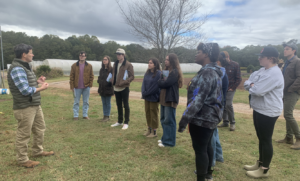
Earlier this year, students in the Land Conservation Clinic visited Woodlawn Gardens Farm, an organic farm near campus, to learn about the process of permanently protecting farms with conservation easements under The Conservation Fund’s Working Farms Program.
The Land Conservation Clinic supports private land conservation efforts in Georgia and the Southeast. A cross-disciplinary program for law and ecology master’s students, the clinic focuses on transactional and policy matters that impact land conservation with clients including nonprofits, government agencies and university researchers, according to Clinical Assistant Professor Steffney R. Thompson.
“My experience in the Land Conservation Clinic taught me that legal tools are only useful if they are practical for the community involved,” second-year student Emily V. Harris said. “The Transfer of Development Rights project allowed me to see that successful conservation is about understanding the totality of the community’s needs, from their economic needs to their environmental needs. Being a lawyer is more than just drafting documents for clients; it is also about finding creative solutions to keep communities sustainable for the next generation.”
Since 2005, the Mediation Practicum has been training law students to become registered neutrals with the Georgia Office of Dispute Resolution. With these skills and the addition of the Mediation Clinic, where students regularly mediate disputes in-person and online for local courts and other entities, UGA Law students are making an impact in the Athens area and beyond. Just how far beyond can be demonstrated by Alexandre Jorge Fontes Laranjeira (LL.M.’23), who serves as a federal court judge in his home country of Brazil. Upon his return to South America, Fontes Laranjeira has used his mediation training and advocated for this dispute resolution skillset to be used more widely within the Brazilian legal system. Rob McNiff (J.D.’02) leads the Mediation Practicum.
The Prosecutorial Justice Program integrates classroom instruction with an externship in prosecutor offices located in Northeast Georgia. Participating students receive three consecutive semesters of classroom instruction from Clinical Associate Professor Melissa D. Redmon beginning in the spring semester of their second year. During their third year, students work in their assigned externship office where they have the opportunity to observe all phases of a criminal prosecution. Under Georgia’s Third-year Practice Act, students can directly participate in conducting preliminary hearings, motion hearings, arraignments, juvenile adjudications, probation revocations, grand jury proceedings and jury trials.

UGA Law regularly participates in a legal pop-up clinic in Troup County that offers free civil legal advice and referrals to residents. Third-year students Supreme Unukegwo (third from left) and Gordon Wayne (second from right) participated under the guidance of Professors Elizabeth Grant (J.D.’94), Emma Hetherington (J.D.’11) (right), Alex Scherr and Ethan Smith (left). The law school’s participation in the Troup County clinic is supported by a Callaway Foundation grant.
The Public Interest Practicum is the School of Law’s longest continuously running civil law clinic. It has spun off or inspired several other clinics, including the Wilson Family Justice Clinic, the Mediation Clinic and the Veterans Legal Clinic, according to Elizabeth M. Grant (J.D.’94), who serves as director. “PIP is a general poverty law clinic that remains a vital part of the law school’s programs by providing research, advice and referrals for low-income people with problems that fall outside other law school clinics or legal services programs.”
Third-year student Supreme Unukegwo said his practicum experiences deepened his understanding of the barriers many people face in accessing the justice system. “At a pop-up clinic … I worked directly with clients who had limited prior access to legal services, and those face-to-face interactions reinforced the importance of listening carefully, building trust, and treating every person’s legal matter with the seriousness it deserves. Throughout each of these experiences, Professor Grant challenged us to go beyond surface-level guidance and deliver the same quality of representation we would provide to any paying client, a standard that fundamentally shaped how I approach client service today.”
This spring marked the 10th anniversary of the Atlanta Semester in Practice program. Since its inception, more than 200 students have externed full-time in the metro Atlanta area at judicial, government, corporate counsel and nonprofit legal offices.
Third-year student Clara McClung Leggett externed for two semesters at the Georgia Department of Agriculture and the Georgia Senate Office of Policy and Legislative Analysis. “I learned the importance of workplace communication, sharpened my research and writing skills, and expanded my network.”
Elizabeth M. Grant (J.D.’94) directs the Atlanta Semester in Practice program.
The School of Law has been offering the Washington, D.C., Semester in Practice since 2012. Under the leadership of Clinical Professor Jessica L. Heywood (J.D.’97), the offering permits students to extern full-time in Washington, while attending classes twice per week. Placements include a wide range of settings, including federal agencies, the White House, national nonprofits, the judiciary and Capitol Hill. The Georgia Law D.C. Semester in Practice Program Endowment provides support for students in this program.
The scope of the Semester in Practice programs has broadened in recent years beyond the cities of Atlanta and Washington, D.C. Students have enjoyed working in other parts of Georgia – from Columbus to Augusta and Ellijay to Savannah. The school has also supported students who externed full-time in other states. Even further afield, clinical faculty partner with the Dean Rusk International Law Center to facilitate international student placements.
Second-year student William P. “Wil” Stowers recently participated in a full-time semester externship at a law firm in Germany. “I learned how to do one of the most difficult things for a law student: how to assume I know nothing,” he said. “While remaining confident in my own abilities, starting from a place of vulnerability allowed me to ask better questions, seek help faster, and to problem-solve more efficiently. While any externship can teach these, only an externship in a different country and in a different legal system will.”
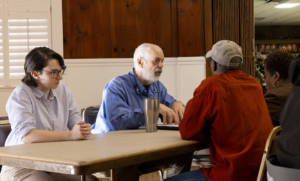
Third-year student Sam Motley (left) and Veterans Legal Clinic Director Alex Scherr speak with attendees of the Stand Down for Veterans event held at the Veterans of Foreign Wars headquarters in Athens during October. Photo by UGA Marketing and Communications.
The Veterans Legal Clinic helps Georgia veterans access the benefits they are entitled to from the U.S. Department of Veterans Affairs. Since opening in 2018, the clinic has aided veterans from across Georgia earn more than $18 million in retroactive awards, debts waived and future payments.
Third-year student Samantha R. “Sam” Motley said working in the clinic helped her discover a passion for an area of law she never thought she would have a sustained interest in professionally. “[M]y two semesters working in the Veterans Legal Clinic have made a major impact on my ability to make a difference in clients’ lives and the kind of lawyer I want to be,” she said. Of note, Motley secured a highly competitive two-year post-graduate fellowship funded by Equal Justice Works. She will start her legal career helping veterans with discharge upgrade requests that will increase their benefits.
After Clinical Professor Emeritus Alexander W. “Alex” Scherr retired in June, Brenda J. Gohr assumed the leadership role for the Veterans Legal Clinic.
James E. “Jim” Butler Jr. (J.D.’77) provided the lead gift and ongoing support benefitting this clinic, and he also provides scholarship support for veterans enrolled at the law school.
The Wilbanks Child Endangerment and Sexual Exploitation Clinic recently obtained an approximately $4.3 million verdict for its client in the Carroll County Superior Court. Third-year law students Hannah M. Peters and Ellis H.P. Schmitt represented the clinic’s client at the trial under the supervision of Staff Attorney Brian Atkinson (J.D.’13), with the support of clinic Director Emma M. Hetherington (J.D.’11) and Social Work Advocate Jocelyn Crumpton.
Since opening its doors in 2016, the Wilbanks CEASE Clinic has provided direct legal and social work services to more than 400 survivors of child sexual abuse, exploitation and trafficking. Marlan B. Wilbanks (J.D.’86) provided the lead gift behind this clinic.
Led by Clinical Associate Professor Christine M. Scartz (J.D.’94), the Jane W. Wilson Family Justice Clinic launched two new projects expanding the geographic reach of the clinic last year. The clinic entered into a partnership with the Gateway Domestic Violence Shelter in Gainesville, GA, to provide representation to victims in virtual protective order hearings in Hall County. Secondly, the clinic began representing women incarcerated in state prisons across Georgia in divorce proceedings.
