


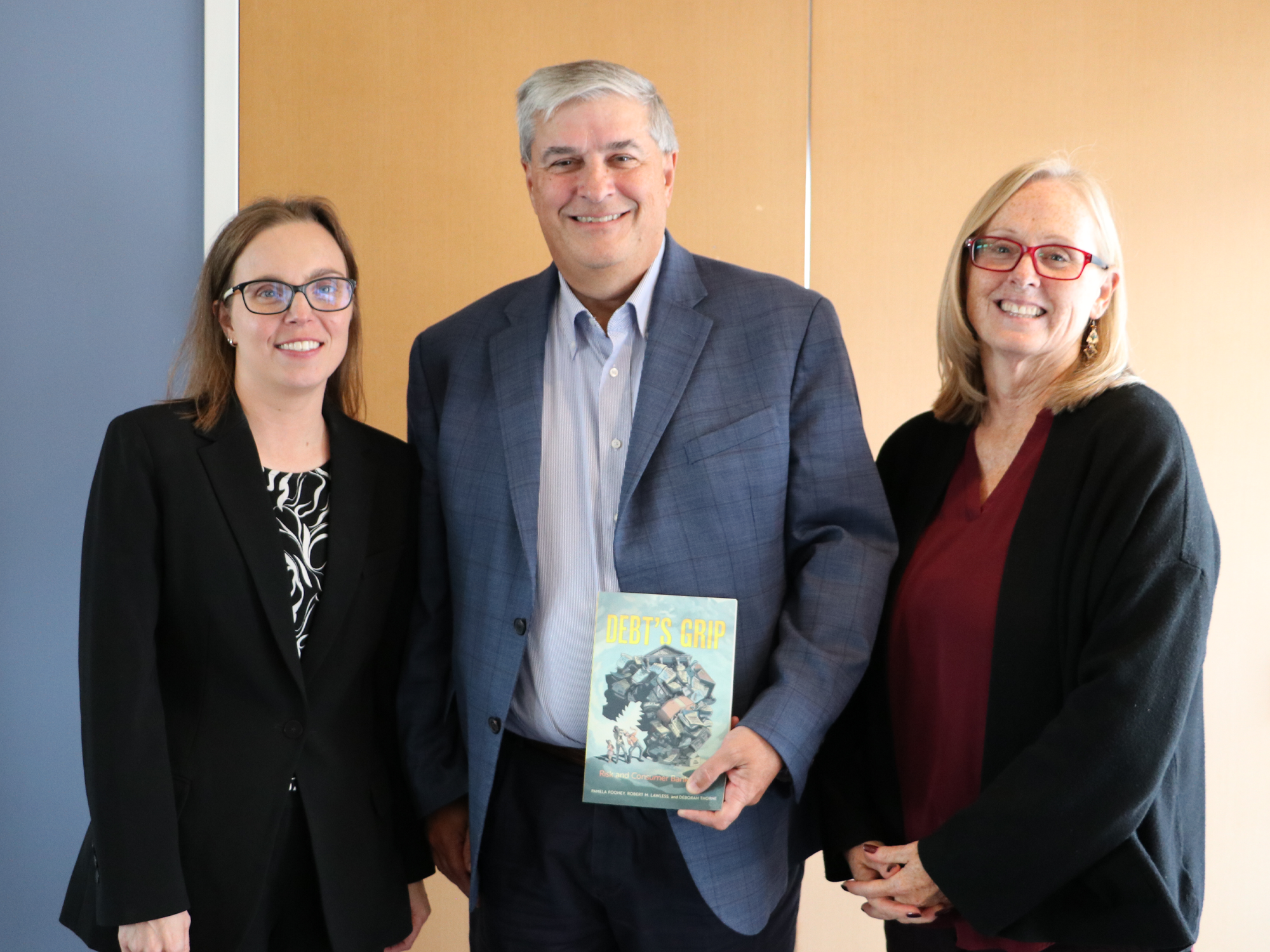

Post Professor Pamela Foohey (left) presented her new book, Debt’s Grip, as part of a conference with co-authors Robert Lawless and Deborah Thorne.
Several conferences brought prominent scholars and speakers to campus for discussions on current topics. Some of these events are highlighted below:
- Post Professor Pamela Foohey hosted a conference in the fall where she presented her new book, Debt’s Grip: Risk and Consumer Bankruptcy (University of California Press, 2025). In addition to her co-authors, Robert M. Lawless and Deborah Thorne, the event brought leading academics to campus to discuss the book and other crucial topics in bankruptcy law.
- Professor Diego Zambrano from Stanford Law School delivered the keynote address at this year’s Georgia Law Review symposium in March. The 2026 symposium, celebrating the 60th volume of the journal, was titled “Polarized Courts: The New Private Enforcement” and featured academics and practitioners from institutions across the country.
- Georgia Supreme Court Justices John J. Ellington (J.D.’85) and Andrew A. Pinson (J.D.’11), along with Supreme Court of Georgia Judicial Law Clerk Alexandria H. “Alex” Clark (J.D.’22), discussed geofence warrants in light of the state Supreme Court’s recent decision in Jones v. State. The event was hosted by the Georgia Criminal Law Review.
- The Journal of Intellectual Property Law symposium tackled the ever-changing landscape of name, image and likeness regulations surrounding college athletics. UGA Sports Law Program Director Myles B. Solomon and 2022 alumnus Tanner L. Potts, the assistant athletic director of player management for UGA Athletics, spoke as part of a panel explaining the intricacies of NIL and how the laws in this arena are constantly shifting. During this conference, the journal staff unveiled the publication’s new name – the Georgia Journal of Law & Technology.
- At the 2026 Red Clay Conference, experts in law, technology and environmental sciences explored the subject of data centers and their overall impact on society. Panelists looked at existing legal structures regarding the centers and their impact on local communities and the environment.
